


Release-film selection depends on perforation, service temperature, resin system and bleeder requirement. The wrong film can disturb resin bleed or surface texture.
Short answer
Release film forms a controlled separation layer between the curing laminate and consumables such as bleeder/breather. A self-releasing surface can reduce the need for extra release agent within its compatible resin and temperature range.
Why does it matter?
Perforated film permits resin and gas transfer, while non-perforated film acts as a barrier. Perforation must match the process objective.
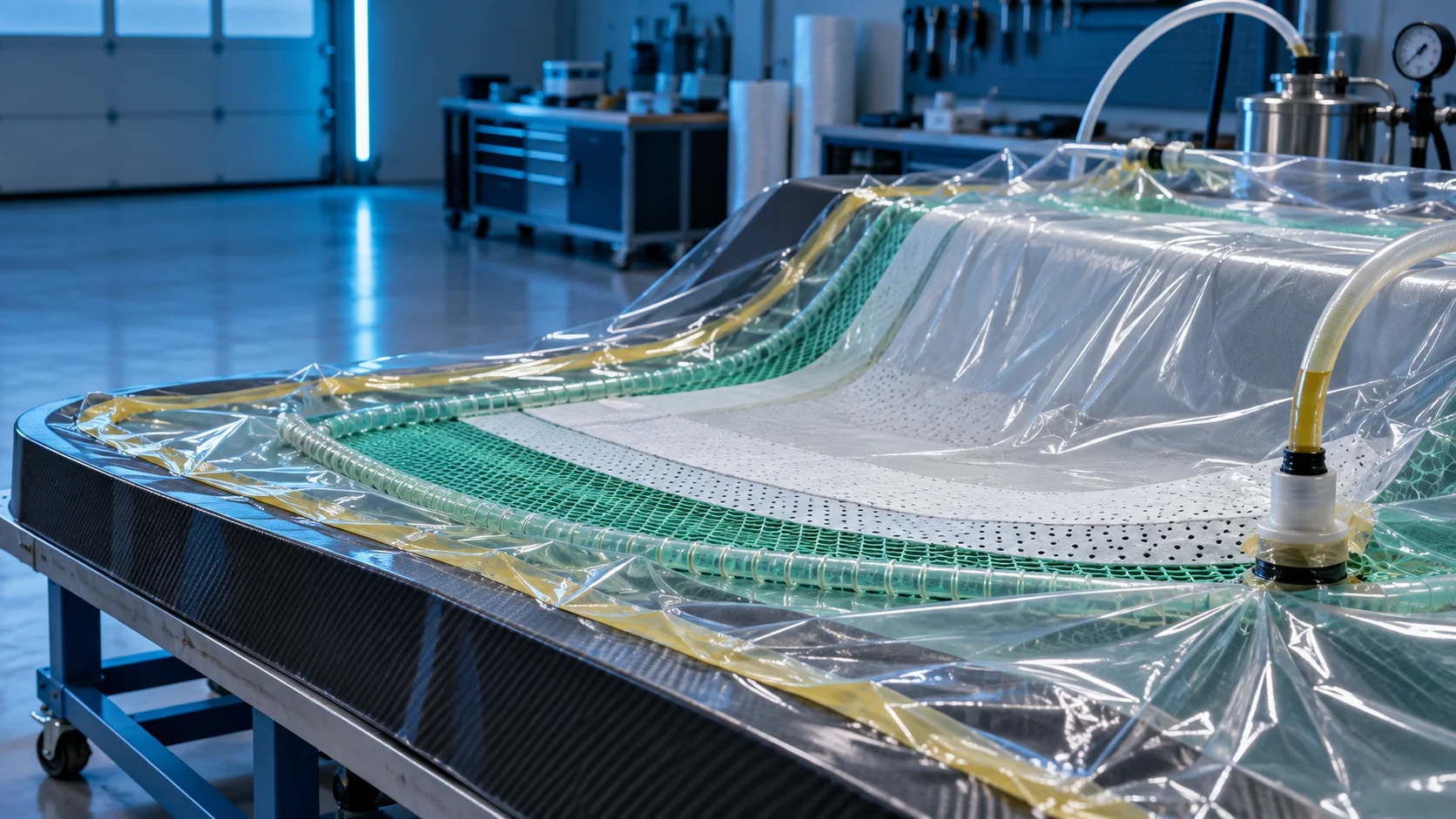
Four questions for the correct film
Select film for the complete vacuum-bagging stack, not temperature alone.
- What is maximum cure temperature?
- Will resin be bled?
- What laminate surface texture is required?
- Should the film be FEP, ETFE, PP or another polymer?
Application errors
Wrinkles, sharp corners and incorrect overlaps may create vacuum bridging or resin pooling. Lay film without stretching over contours or blocking flow paths.
- Protect sharp edges
- Place overlaps for the flow direction
- Select temperature class with a safety margin
Frequently asked questions
Do perforated and non-perforated films do the same job?
No. Perforated film allows controlled transfer; non-perforated film is used as a release barrier.
Can release film be reused?
Most release films are single-use unless the product documentation explicitly states otherwise.
Conclusion and technical support
Select film, peel ply and flow mesh together with our vacuum-infusion consumables guide.
Sources
- Ürüne bağlı üretici TDS ve sıcaklık sınıfı belgesi